
Amid mounting economic pressures in Egypt and Saudi Arabia, financial restructuring has become a strategic necessity rather than a luxury. At NHG Experts for Business Development, we believe that a company that reorganizes its financial structure at the right time preserves its liquidity and secures its future. This guide walks you through the optimal solution, step by step.
Early Warning Signs That Your Company Needs Financial Restructuring Before the Crisis Deepens
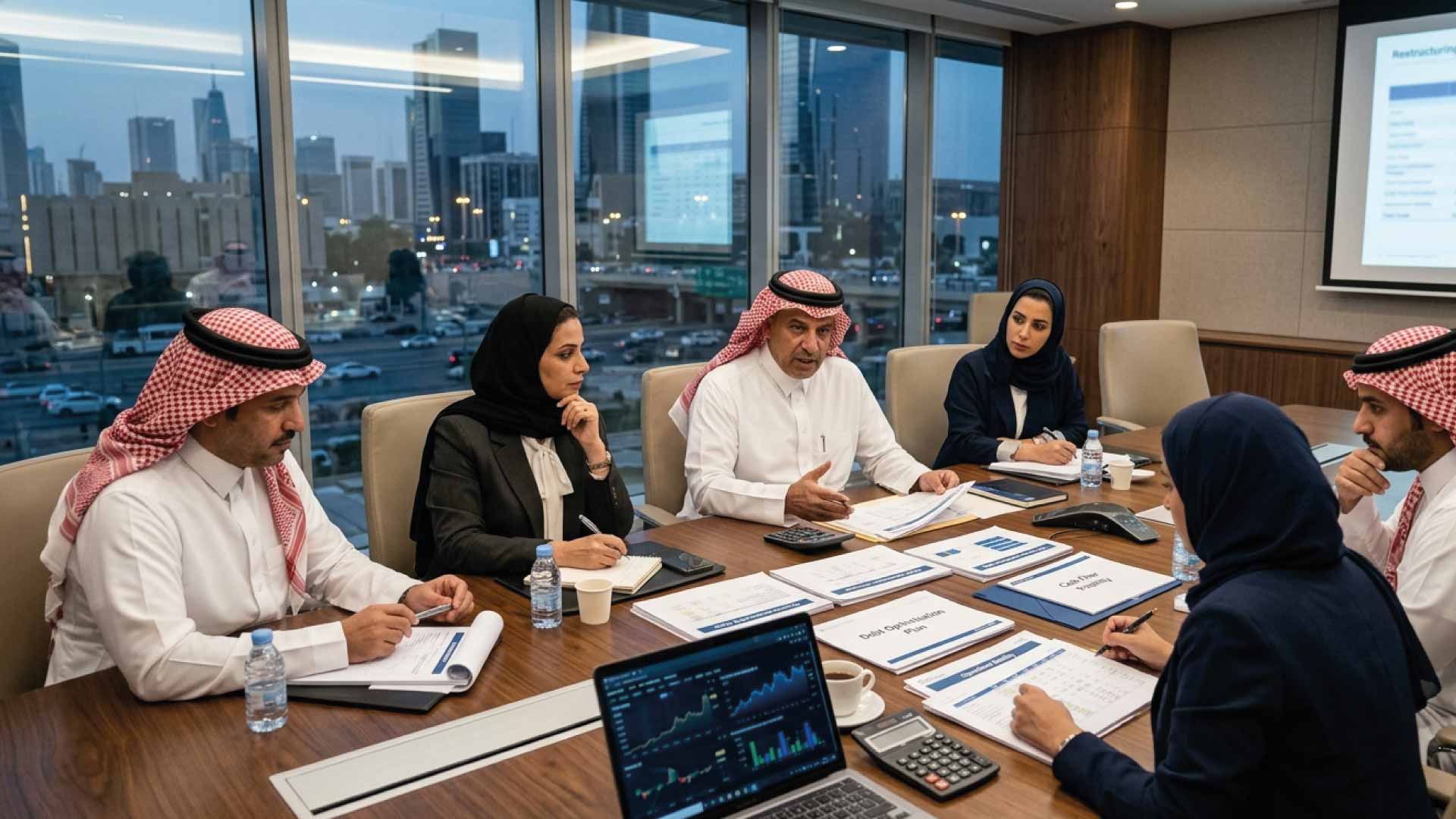
How to Calculate Liquidity Ratios and the Interest Coverage Ratio to Diagnose the Need for Financial Restructuring
The journey of financial restructuring begins with an accurate diagnosis. The most telling indicators include growing difficulty in servicing debt, where interest installments consume most of the operating cash flows. The interest coverage ratio is the key metric here; when it falls below one, it means earnings are insufficient to cover interest payments alone. Equally critical is the deterioration of operational liquidity management to dangerous levels when current assets fall below current liabilities. Understanding warning indicators of company distress and restructuring needs forms the ideal analytical framework for diagnosing these situations across Egyptian and Gulf markets.
Selling and Leaseback of Non Core Assets to Improve Liquidity Without Disrupting Operations
Selling and Leaseback of Non Core Assets converts real estate and spare machinery into immediate cash while keeping the asset in service. Improving the structure of assets and liabilities on the balance sheet is further reinforced by the technique of reducing share capital then increasing it to address accumulated losses, whereby share values are written down to reflect losses and shareholders are then invited to inject fresh funds at a reduced price, without requiring any cash from the company itself. It is essential to focus on managing financial distress before reaching insolvency through these preventive tools, before a crisis escalates into a liquidation that wipes out shareholders’ equity. This is precisely what financial restructuring in Egypt is establishing as a professional institutional practice.
How Asset-Liability Maturity Mismatches Undermine a Company’s Financial Stability
One of the most common financing mistakes is funding long-term assets with short-term loans, which compounds the financial restructuring challenge down the line. Improving the structure of assets and liabilities means ensuring alignment of asset and liability maturities to avoid being trapped in a cycle of costly loan rollovers. Escalating pressure from creditors and suppliers demanding upfront payment signals that credit risk management for companies in an inflationary environment has become a strategic imperative. All these factors make financial restructuring for distressed companies in Egypt and Saudi Arabia an indispensable path to restoring stability.
Objectives of Financial Restructuring: Reducing Financing Costs, Improving Liquidity, and Restoring Balance
Financial restructuring pursues a set of integrated goals.
- First is reducing financing costs by renegotiating interest rates and replacing high-cost instruments with more affordable ones.
- Second is improving liquidity management in Egyptian and Saudi companies to ensure uninterrupted operations.
- Third is restoring the confidence of creditors, suppliers, and clients when they see a clear remediation plan in place.
- Fourth is to address the impact of restructuring on the company’s market value by keeping the company operational and productive rather than entering an insolvency spiral.
At NHG Experts for Economic Consulting, these goals sit at the core of every restructuring plan we design.
Request a complimentary financial diagnostic session to assess your company’s need for financial restructuring and debt relief | WhatsApp: 01001189403
You can also read:
- Investment opportunities with a financial consulting office
- Opportunities for foreign investor in Saudi Arabia
- Economic Feasibility Study Office Services
- Impact of regional geopolitical tensions on Gulf investment
Financial Restructuring Tools That Can Be Applied Without Touching the Company’s Operational Liquidity
Practical Steps for Debt Rescheduling and Negotiating with Banks and Suppliers in the Egyptian and Gulf Markets
Debt rescheduling with banks and creditors is the most widely used and effective tool: extending maturity dates and granting grace periods relieves immediate pressure without draining liquidity. Debt rescheduling is the safest entry point for initiating financial restructuring negotiations. Companies can also negotiate with suppliers to extend payment terms from thirty to ninety days in exchange for volume commitments, providing a liquidity buffer at no direct cost. Experts in executing financial restructuring for distressed companies without draining operational liquidity in Egypt and Saudi Arabia recommend starting with one major creditor and using that success as a replicable model.
Mechanism of Converting Part of the Debt into Equity Stakes and Its Impact on Capital Structure
Converting debt into equity stakes in companies requires no cash outflow from the company; it simultaneously reduces liabilities and strengthens equity. Debt to equity conversion allows the creditor (whether a bank or investment fund) to enter the ownership structure in exchange for forgiving part of the debt. Alternative financing strategies for working capital serve as a complementary option, including injecting new capital from investors who see opportunity in the distressed company. Together, these tools constitute the core of financial restructuring services delivered by NHG Experts for Consulting in the Egyptian and Saudi markets.
Let our team at NHG Experts design a financial restructuring plan that protects your liquidity and secures business continuity in Egypt and the Gulf | WhatsApp: 01001189403
The Importance of Early Planning and Building a Financial Map Before Entering Restructuring Negotiations with Creditors
Steps to Prepare an Accurate Financial Map Before Starting Financial Restructuring with Creditors and Suppliers
Financial restructuring in Saudi Arabia and neighboring markets begins with an accurate financial map: inventorying all debts, maturities, and interest rates; analyzing cash flows over the past twelve months; and modeling multiple scenarios for the year ahead. The best financial restructuring tools to reduce financing costs and restore the balance between assets and liabilities all rest on this analytical foundation. The role of the financial advisor in restructuring processes is pivotal, leading negotiations, designing solutions, and ensuring alignment with regulatory frameworks such as Egypt’s Financial Regulatory Authority and Saudi Arabia’s Capital Market Authority. Financial restructuring models in the Saudi and Gulf markets have consistently shown that early intervention significantly reduces the total cost of a financial crisis.
How financial restructuring helps rescue companies before reaching insolvency and liquidation ? the answer lies in timing. A company that proactively engages its creditors before complete payment cessation finds far more cooperative counterparts. Restructuring as a proactive choice rather than an alternative to liquidation is the principle that effective financial restructuring consulting reinforces. The role of the specialized financial advisor in designing and executing a financial restructuring plan in Gulf markets extends beyond numbers to managing expectations and preserving relationships with all stakeholders.
Visit our website at nhgexperts.com/en to explore the full range of our services
Book a specialized consultation to negotiate with banks and suppliers and reschedule debts on more favorable terms | WhatsApp: 01001189403
You can also read:
- Financial evaluation of startups
- Feasibility studies for small projects in Egypt
- Market research and studies for startups in Egypt
- Administrative restructuring of Gulf family businesses
Conclusion:
Financial restructuring is not an admission of failure; it is a decision rooted in wisdom and foresight. The smart company is the one that senses early the need to reorganize its financial architecture, thereby preserving its liquidity and maximizing value for its owners. Whether through debt rescheduling, converting debt to equity, or divesting non-strategic assets, there is always a path to survival. What is required is the courage to confront reality, the skill to negotiate, and the wisdom to choose the right advisor. Our team at NHG Experts for Business Development stands ready to accompany you at every step toward financial stability and sustainable growth.
Contact us to assess your asset-liability structure and build financial restructuring scenarios before pressures escalate. WhatsApp: 01001189403
Frequently Asked Questions:
What is the difference between financial restructuring and operational restructuring, and which should come first?
Financial restructuring focuses on the balance sheet and funding sources, while operational restructuring addresses internal processes and efficiency. Ideally, both run concurrently, or the financial side precedes the operational one; fixing the numbers means little if the core business is broken. However, an acute financial crisis demands immediate attention to the financial dimension first.
When is financial restructuring a better proactive option than entering insolvency or liquidation proceedings?
When the company still generates revenue and holds valuable assets, financial restructuring is far more beneficial than liquidation. It preserves jobs, brand equity, and client relationships, while offering creditors a genuine prospect of full recovery rather than a distressed fire sale.
How does financial restructuring affect the company’s relationships with banks, suppliers, and clients in the short term?
In the short term, some parties may be cautious, but a clear plan and transparent communication accelerate the restoration of trust. Banks prefer a company that negotiates over one that ignores its obligations, and suppliers respond positively to payment deferrals when they sense genuine commitment from the client.
What qualifications should a financial advisor possess to successfully lead a financial restructuring process in Egypt and Saudi Arabia?
The advisor must have a documented track record in Egyptian and Gulf markets, thorough knowledge of local regulatory frameworks, and strong negotiating capacity with banks and creditors. Fees should be partially tied to the success of the process, and the advisor should maintain an established network with major financial institutions. This is precisely what sets the team at NHG Experts for Business Development apart in the region.
Authored by Dr. Hossam El-Ghayesh
Head of the Advisory Team | Expert in Capital Markets and Economic Feasibility Studies